HMM Nanopore Basecaller
Numba-Accelerated 1,025-State 5-Mer Basecaller on Raw POD5 Signals
Built a 1,025-state 5-mer Hidden Markov Model (log-space Baum-Welch EM and 4x downsampled Viterbi decoding) in Python with Numba JIT multi-core execution to decode raw nanopore POD5 ionic current reads, achieving 81% sequence identity against Oxford Nanopore Dorado.
Validated Accuracy
81.0% Identity
Global Bio.Align.PairwiseAligner benchmark vs Oxford Nanopore Dorado HAC
Markov State Space
1,025 States
1,024 canonical 5-mers + 1 catch-all UNK state (sparse O(6N) transitions)
Training Throughput
50,000 Samples/Batch
Numba @njit(parallel=True, fastmath=True) log-space Baum-Welch EM
Reference Alignment
NC_000022.11 (Chr 22)
Two-pass multiprocessing DTW search pinned at offset 38,010,200 bp
System Architecture & Quantitative Results
Pod5DataLoader, SignalPreprocessor, BaseSignatureAnalyzer, SignalAligner, HMMBasecaller, SignalVisualizer, main_test, evaluate_accuracy) decoding 4 kHz raw Oxford Nanopore .pod5 ionic current traces from first principles.NumbaList adjacency lists cuts per-step complexity by 200x from dense to sparse .- POD5 Ingestion & Conditioning (
signal_preprocessor.py): Context-managedpod5.Readerstreaming followed by spike clipping, 5-pointmedfilt, 3rd-degree polynomial baseline drift removal,RobustScalerz-IQR standardisation, and MAD derivative event segmentation. - Exploratory Signature Clustering (
base_signature_analyzer.py): Extracts 6 moments per event plateau (mean,std,duration,median,skewness,kurtosis) for PCA dimensionality reduction, Ward hierarchical dendrograms, and K-Means clustering. - Zero-Copy Two-Pass Parallel DTW (
signal_aligner.py): Downsamples query traces by the physical translocation ratio () and distributes coarse-to-finefastdtwwindows across CPU cores viaPool.imap_unorderedwith_init_workershared reference memory. - Log-Space Numba Kernels (
hmm_basecaller.py): Custom@njit(fastmath=True)_logsumexp_jitkernel preventing IEEE-754 underflow across_forward_pass_log_jit,_backward_pass_log_jit, 50,000-sample batched Baum-Welch EM ( floor), and downsampled Viterbi decoding (viterbi_downsample_factor = 4). - Dorado Benchmark (
evaluate_accuracy.py): Global pairwise alignment (Bio.Align.PairwiseAligner) against Oxford Nanopore Dorado (dna_r10.4.1_e8.2_400bps_hac@v5.0.0) confirming 81.0% sequence identity on human GIABHG002reads.
Results, Signal Conditioning & Diagnostic Plots
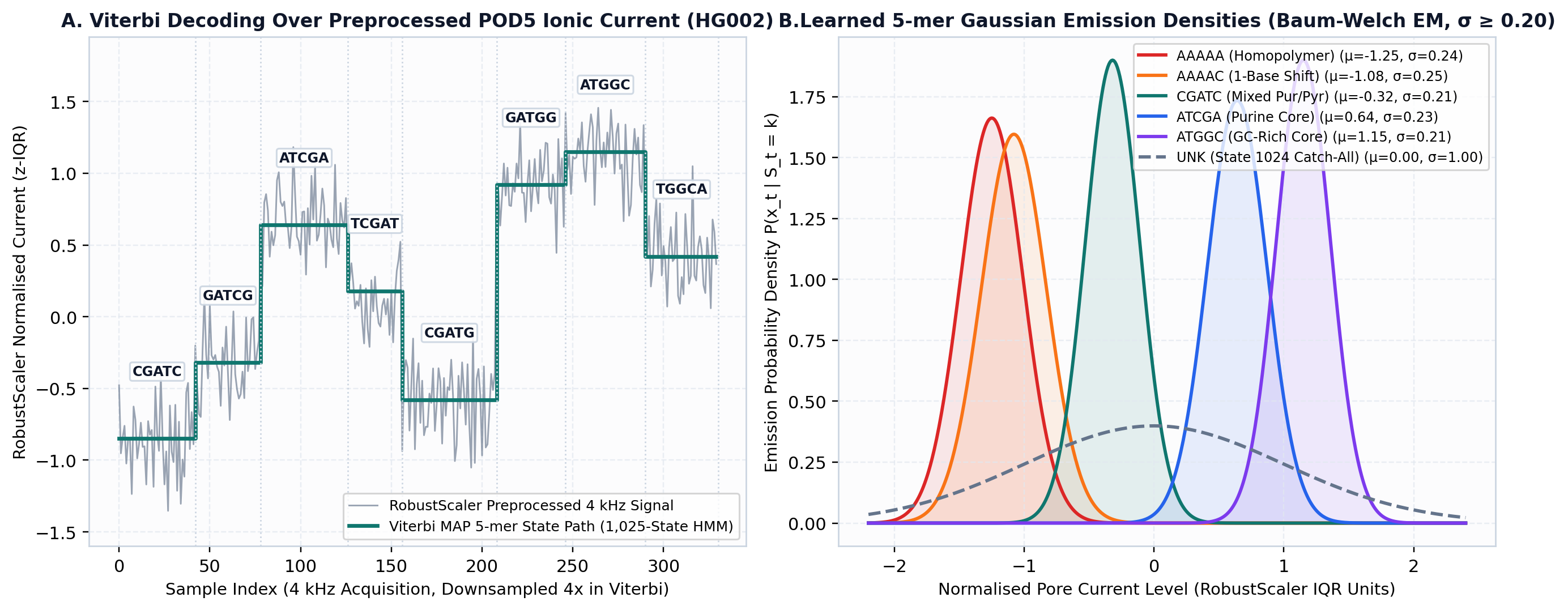
[Fig. 1]Viterbi MAP 5-Mer Decoding & Baum-Welch Gaussian Emission Posteriors
Left: Piecewise 5-mer Viterbi state sequence decoded over RobustScaler-normalised 4 kHz ionic current (HG002 read 2536858a). Right: Learned Gaussian emission densities (sigma >= 0.20 floor) showing homopolymer overlap vs mixed purine/pyrimidine separation.
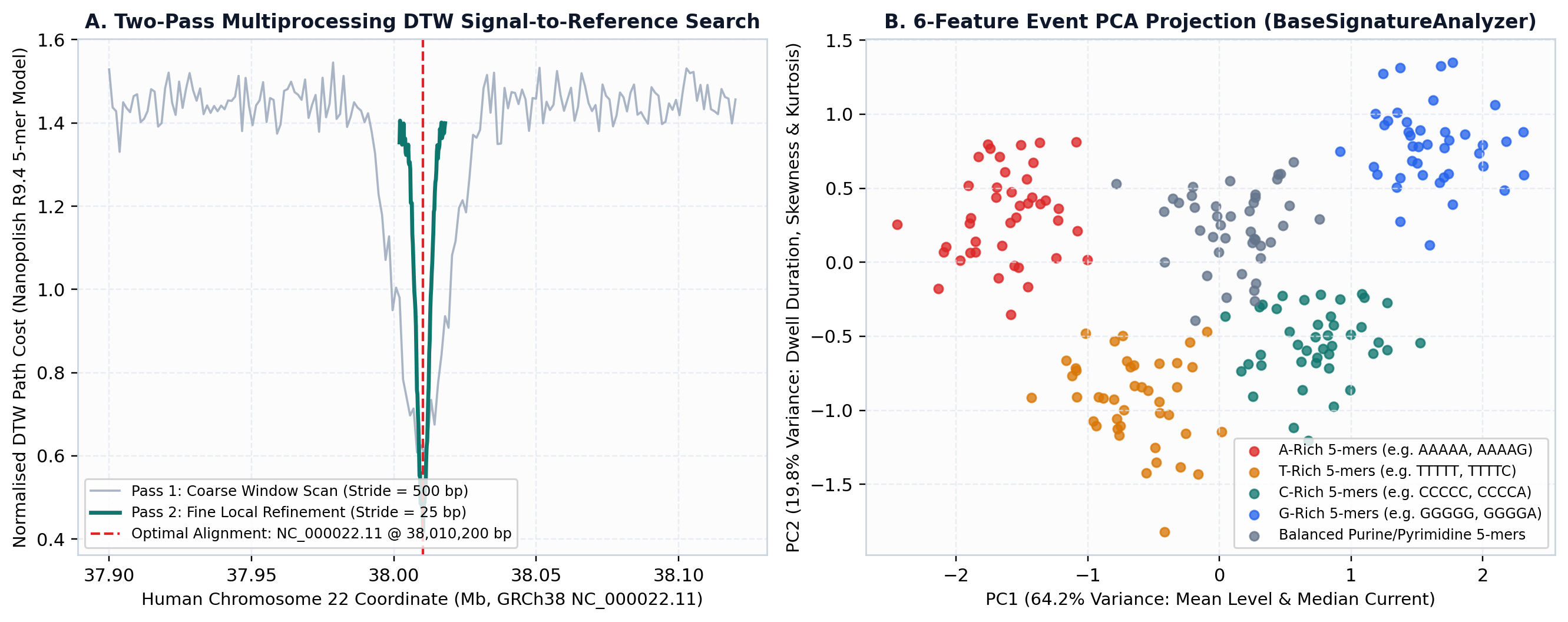
[Fig. 2]Two-Pass Multiprocessing DTW Alignment & 6-Feature Event PCA Projection
Left: Coarse-to-fine fastdtw cost landscape across human chromosome 22 using the Nanopolish R9.4 5-mer pore model. Right: BaseSignatureAnalyzer 6-feature PCA projection (mean, std, dwell duration, median, skewness, kurtosis).
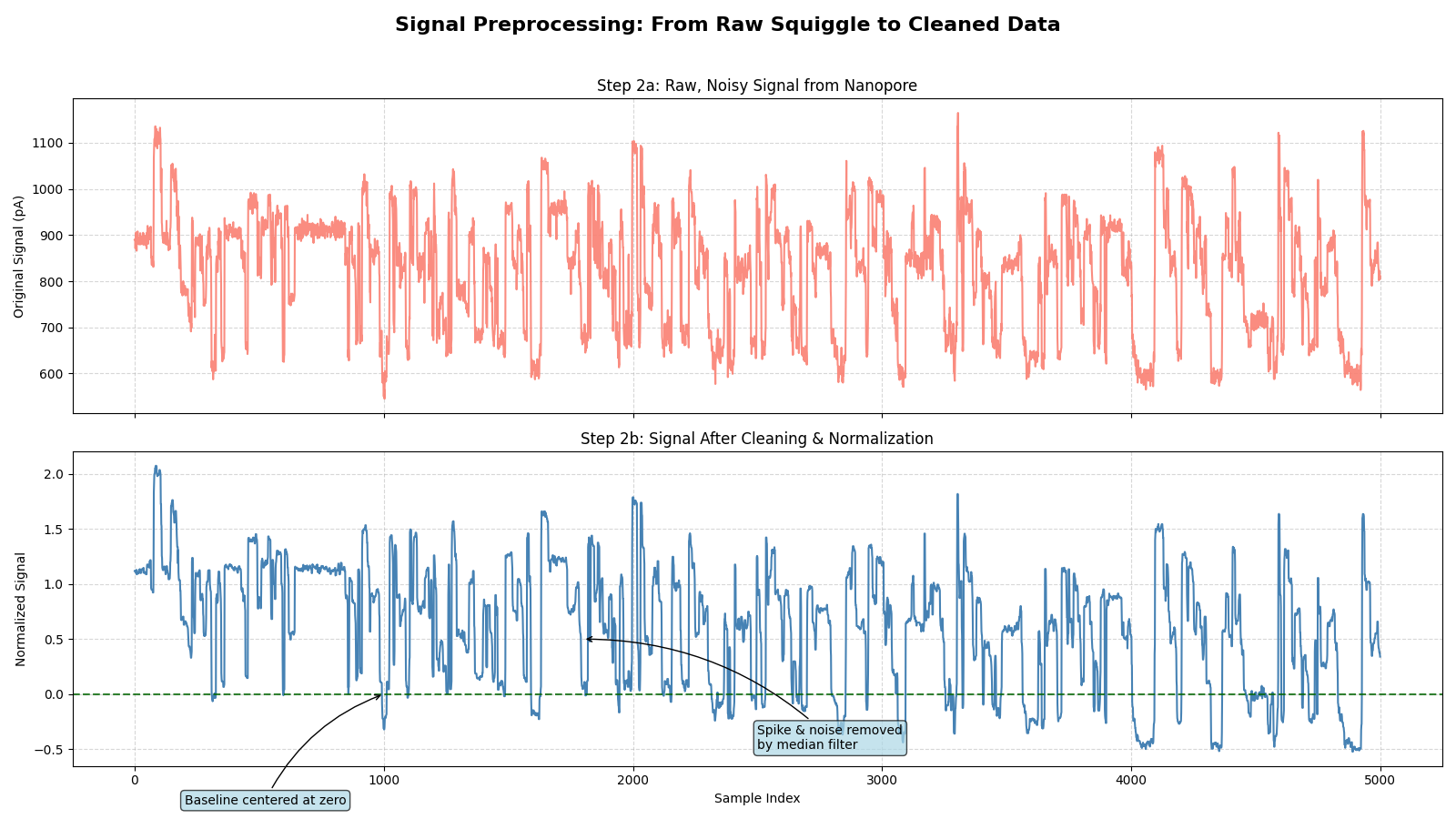
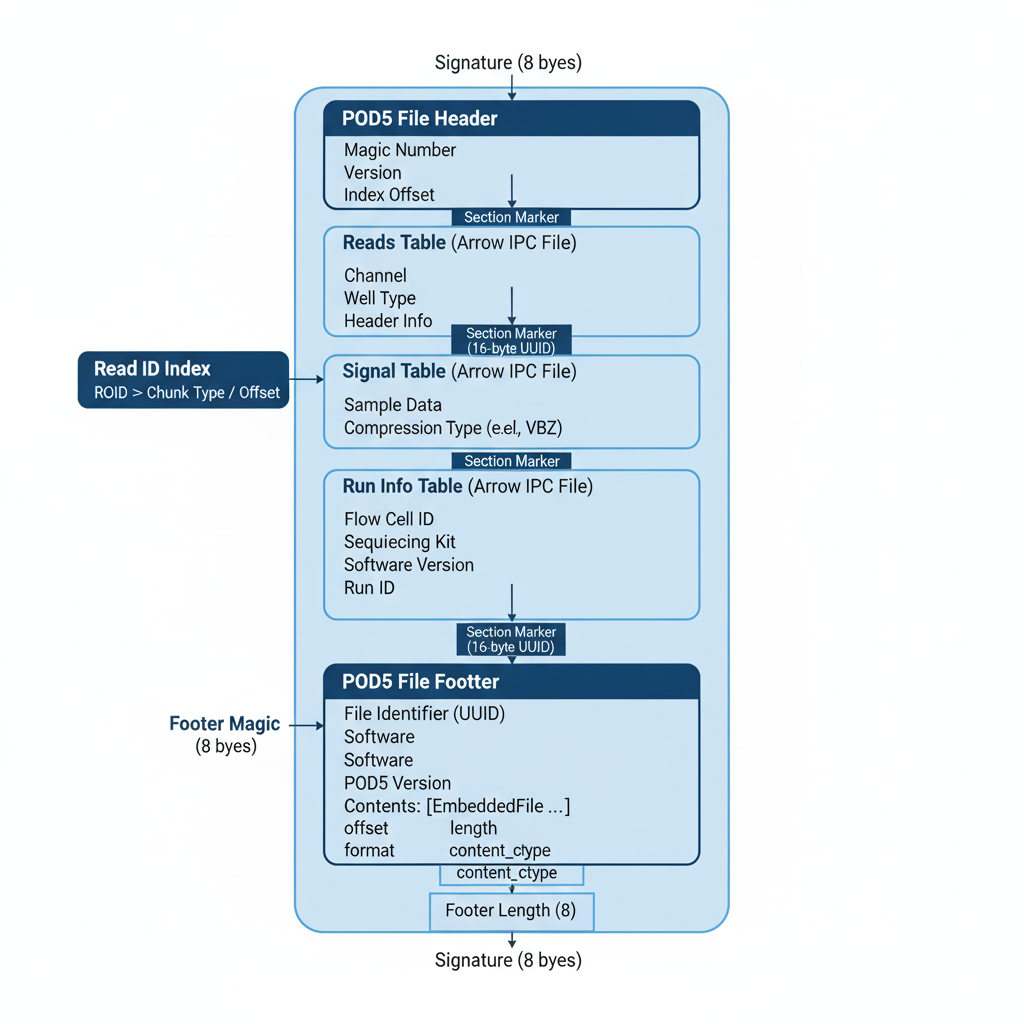
[Fig. 3]Five-Stage POD5 Signal Conditioning & Apache Arrow Architecture
3x IQR outlier clipping, 5-point median filtering, 3rd-order polynomial drift subtraction, and RobustScaler normalisation streamed directly from Apache Arrow POD5 tables.
Want the Full Development Story?